
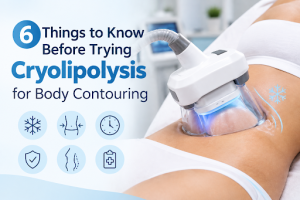
A person can reach a weight they are genuinely satisfied with and still have one specific area, often the flanks, lower abdomen, or inner thighs, that simply hasn’t responded to months of consistent training and honest effort. That precise frustration is usually what brings someone to cryolipolysis treatment in the first place.
But choosing cryolipolysis isn’t really about wanting less fat in general. It’s about whether that particular area, its shape, its tissue, and its history match what the treatment is actually built to address. Candidacy, timing, realistic outcomes, and safety all deserve a proper look before booking anything at all.
Key Takeaways
- Cryolipolysis reduces localised fat through controlled cooling; it is not a weight-loss treatment.
- Suitability depends on whether fat in a specific area is pinchable and treatable, not just on the desire for a slimmer silhouette.
- Visible results take weeks because the body gradually clears treated fat cells.
- Paradoxical adipose hyperplasia is a rare but real risk worth including in any informed consent conversation.
- Treatment parameters, applicator fit and practitioner assessment shape outcomes as much as the technology itself.
1. Cryolipolysis Targets Localised Fat, Not Weight
Cryolipolysis is based on the controlled cooling of a treatment area. This destroys vulnerable fat cells, or adipocytes, without any impact on the surrounding skin.
Over the following weeks, the body gradually clears that damaged tissue through its processes. Nothing “melts” or “burns” on contact, and nothing disappears immediately.
The distinction matters because the treatment doesn’t act on fat throughout the body. The FDA’s overview of non-invasive body contouring technologies notes that these devices are intended for localised fat reduction, and none are approved for obesity or weight-loss treatment.
2. Candidacy Matters More Than the Treatment Name
Wanting fat freezing treatment isn’t the same as being a good fit for it. Suitability depends first on whether there’s enough pinchable, treatable subcutaneous fat in the area, since the applicator has to draw tissue in to cool it effectively.
Skin laxity, the underlying contour, prior scarring, and general medical history all factor into whether an area is appropriate. An area with the right fat volume but poor skin quality can still produce a disappointing result.
Research on candidate selection stresses the need to assess localised adiposity and treatment-area characteristics carefully, rather than assuming that any visible fat qualifies. The right candidate is someone whose contour concern actually lines up with what cryolipolysis is built to treat, not simply someone carrying extra fat somewhere on their body.
3. Results Develop Gradually
Nothing about cryolipolysis produces an instant change. Treated fat cells are cleared over time rather than removed on the spot, so the appearance immediately after a session tells you very little.
Most patients notice change building over the following weeks, with individual timelines varying by treatment area, protocol, and personal response.
Comparing photos too early tends to create disappointment that has nothing to do with whether the treatment is working. The body is still in the process of clearing tissue that was never going to disappear overnight.
4. The Amount of Contour Change Varies
A 2026 meta-analysis of cryolipolysis studies found reductions in local circumference and fat thickness in treated areas and measurable reductions in BMI. Body weight was not significantly altered.
The review also noted that benefits varied by body region and tended to be more pronounced in shorter-term follow-up. A number from one study, on one body area, isn’t a promise for a different one.
The applicator, protocol, treated area, and individual tissue response all shape the outcome, and some areas reasonably call for more than one session. What the treatment offers is contour refinement, proportionate to the fat actually present, not a substitute for non-surgical fat reduction achieved through diet or overall weight change.
5. Recovery Is Usually Manageable, But Effects Are Real
Redness, swelling, bruising, tenderness, and temporary numbness or altered sensation in the treated area are common in the days following cryolipolysis. Some patients also notice temporary skin discolouration.
A follow-up study of patients after treatment in 2025 found that these effects were generally most apparent in the first week or two and tended to wane over time for most patients. The pattern remained unique to each individual.
None of this amounts to a painless or downtime-free procedure. Planning for some visible after-effects is more useful than assuming there won’t be any.
6. Know the Safety Considerations, Including PAH
Paradoxical adipose hyperplasia, or PAH, is an uncommon but clinically important complication where the treated area enlarges rather than shrinks. It can take months to become noticeable.
A 2025 systematic review pooling 28 studies and over 13,000 patients estimated the incidence at roughly 0.22%. The authors noted the certainty of that estimate was low, and follow-up was inadequate in several of the included studies.
PAH doesn’t resolve on its own in most reported cases and can require surgical correction. It’s rare, not a reason to view cryolipolysis treatment as inherently risky, but it belongs in any honest conversation before treatment.
The FDA’s guidance also outlines contraindications related to cold sensitivity and circulation, along with treatment-area considerations a qualified provider should screen for beforehand. More cooling or a longer session isn’t a shortcut to a better result; it’s simply a different risk profile.
Choosing Cryolipolysis in Dubai
The outcome depends more on assessment than on the device alone, which is why the practitioner matters as much as the technology.
A proper consultation should evaluate the area directly, discuss realistic expectations, and cover the relevant risks, PAH included, rather than treating cryolipolysis as a fixed procedure applied the same way to everyone.
Patients in Dubai considering their options can discuss their goals with a qualified clinical team at AestheticsCC, where individual assessment determines whether cryolipolysis, or another approach entirely, actually fits the concern.
Frequently Asked Questions
Is cryolipolysis a weight-loss treatment?
No. It works on localised fat in specific areas, not on overall weight. Someone hoping it will move the number on a scale is going to be disappointed; that’s just not what it’s built to do.
How long does it take to see cryolipolysis results?
A few weeks, usually, as the body clears out the treated fat cells on its schedule. How long exactly depends on the area, the protocol used, and how your body responds.
Is cryolipolysis safe?
For most people, yes, the side effects are mild and temporary. There’s a rare complication called PAH worth knowing about too, which is precisely why a proper screening beforehand isn’t optional.
Can cryolipolysis be done on any part of the body?
Not really. It works best on areas with enough pinchable fat for the applicator to grip, like the abdomen, flanks or thighs. Some areas just don’t work well with the technology.